Geithner: Don’t shrink financial services!
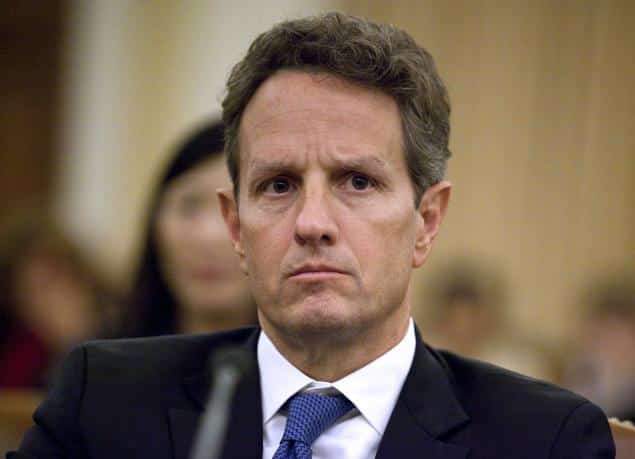
This comes via Noam Scheiber at the New Republic (emphasis added):
Geithner hunched his shoulders, pressed his knees together, and lifted his heels up off the ground—an almost childlike expression of glee. “We’re going, like, existential,” he said. He told me he subscribes to the view that the world is on the cusp of a major “financial deepening”: As developing economies in the most populous countries mature, they will demand more and increasingly sophisticated financial services, the same way they demand cars for their growing middle classes and information technology for their corporations. If that’s true, then we should want U.S. banks positioned to compete abroad.
“I don’t have any enthusiasm for … trying to shrink the relative importance of the financial system in our economy as a test of reform, because we have to think about the fact that we operate in the broader world,” he said. “It’s the same thing for Microsoft or anything else. We want U.S. firms to benefit from that.” He continued: “Now financial firms are different because of the risk, but you can contain that through regulation.” This was the purpose of the recent financial reform, he said. In effect, Geithner was arguing that we should be as comfortable linking the fate of our economy to Wall Street as to automakers or Silicon Valley.
One can disagree with this substantively. Financial reform is a good start, with its stricter rules and new authority for regulators. But whether Wall Street can be made to behave like a normal industry rather than a source of economy-wide instability remains very much open to debate.
Still, the bigger question may be political. Is this a moment when the country demands a wholesale reimagination? A bet on Geithner going forward is a bet that the financial sector can regain its democratic legitimacy without being shrunk or radically restructured. Perhaps as much as the successes of the past two years, Geithner’s legacy will ultimately depend on how well Wall Street meets that test.
Read the whole thing. It’s a good piece for understanding Geithner’s thinking. He wants American banks to penetrate emerging markets and get even bigger. How this benefits the U.S. economy is unclear, however. It reminds me of the Slate piece from December 2009 when Geithner said the Obama Administration needed to override the popular sentiment against banks and bail them out in order to beat back the economic downturn.
I wrote a few months later:
this was a ruse to let the banks grow their way out of the crisis like Japan, albeit after they had already received huge capital injections from the private sector. That’s why big banks are earning gobs of money with interest rates at zero percent. If it weren’t for all the hidden losses, we’d be home free.
–Geithner: jusqu’ici tout va bien, Mar 2010
As for bank losses, Michael Pettis writes compellingly in the Chinese context that the real cost of non-performing loans is a socialization of them over the wider populace. Pettis writes:
Throughout modern history, and in nearly every economic system whether we are talking about China, the US, France, Brazil or any other country, there has really only been one meaningful way to resolve banking crises. Whenever non-performing loans or contingent liabilities surge to the point where the solvency of the banking system is threatened, the regulators ensure that wealth is transferred in sufficient amounts from the household sector to borrowers or banks to replenish bank capital and bring them back to solvency. The household sector, in other words, always pays to clean up the banks.
There are many ways to make them pay. In some cases, and certainly in the US before the 1930s, banks simply defaulted and their depositors absorbed the full loss. In that case it was the actual bank depositors, mainly households, who directly bore the full cost of the losses, in the form of reduced, or sometimes no, repayment of their deposits.
Largely because this kind of system creates incentives for bank runs, regulators developed alternative systems, by which governments guaranteed deposits and otherwise bailed out the banks, and paid for the bailout by raising taxes. In that case the household sector still paid for the losses, but they did so largely in the form of taxes, and the losses were spread out throughout the population.
Of course this way of bailing out the banks is politically unpopular and always leads to uncomfortable calls to punish the banks for their behavior. If the regulators are given a longer amount of time during which to clean up the banks, they can use other, less obvious and so less politically unpopular, ways to do the same thing, for example by managing interest rates. In the US and Europe it is fairly standard for the central bank to engineer a steep yield curve by forcing down short-term rates. Since banks borrow short from their depositors and lend long to their customers, the banks are effectively guaranteed a spread, at the expense of course of depositors. Over many years, the depositors end up recapitalizing the banks often without realizing it.
As I argued in the post on Bank Bailouts Explained, most of the bailouts will always be in the form of hidden subsidies and backdoor bailouts to minimise public anger. Even so, bailouts are always a gamble, a roll of the dice. If they underestimate needed capital and fail, then the government loses credibility and crisis ensues. This is what we have witnessed in Europe.
I should also point out that bailouts are seductive to policy makers because they can work even if the underlying economic fundamentals are suspect. If policy makers are able to kick the can far enough down the road and put enough time between the bailout and its inevitable consequences, they may escape blame for the inevitable crisis. The Savings and Loan crisis is a perfect example of this kind of thinking.
As for the most recent U.S. bailouts, I wrote last August On How Tim Geithner and I agree on public policy to demonstrate how all of the government programs are designed to recapitalise the banks. The key differences between Geithner and me are that I don’t believe the ends justify the means and I don’t believe we had a liquidity crisis; I believe we are in a solvency crisis which is still on-going. I would argue that crisis will return to the U.S. as well when the next downturn hits because of debt in the state, local and household levels as well as hidden losses in the financial sector. But that is a ways off yet. For now, the narrative that has gained momentum is one of stock market boom and sustainable recovery. If this narrative holds through 2012, Barack Obama will benefit.

November 2012 is a long way off and it might cost trillions to keep the banks rolling along till then. The overall problem with insolvent banks being supported this way is that they get bigger and so do the problems. Banks should only operate within one country if they are to get state support. If it is part of a bank holding company how do we know that the bail out is not being used to cover up bad losses in some other country? I do support lend of last resort but the costs should be high not zero percent interest rates.
November 2012 is a long way off and it might cost trillions to keep the banks rolling along till then. The overall problem with insolvent banks being supported this way is that they get bigger and so do the problems. Banks should only operate within one country if they are to get state support. If it is part of a bank holding company how do we know that the bail out is not being used to cover up bad losses in some other country? I do support lend of last resort but the costs should be high not zero percent interest rates.
Heavy sarcasm here: The banks performed so well we should definitely design regulation to let them perform similarly on a global scale.
Heavy sarcasm here: The banks performed so well we should definitely design regulation to let them perform similarly on a global scale.