Argentina Fundamentals Still Deteriorating
By Win Thin
After all the media coverage of Argentina’s move to seize a controlling stake in oil company YPF, there are still some points worth highlighting. This move is simply the latest in a string of market-unfriendly moves by the government. While former President Kirchner was not in power when Argentina defaulted, he was during the 2005 debt restructuring that shoved big haircuts down the throats of investors. His wife and current President Fernandez has taken the ball and run with it, having presided over the seizure of $29 bln in private pension fund assets back in 2008 as well as price caps, regulatory and anti-business measures, and countless others that have stifled the private sector.
Fernandez said that inadequate investment in exploration and production was the rationale behind the decision to seize YPF, but given price caps on energy and other regulatory measures that cut into profits, it’s no surprise that YPF could not or would not commit more resources to its Argentine operations. There are plenty of negative implications for Spanish parent company Repsol, but we do not think there are any implications to the Spanish sovereign outlook as a result of the seizure. Still, the seizure couldn’t have come at a worse time for Rajoy, as he struggles with budgetary issues.
Basically, Fernandez is doubling down on its past policies that have done nothing but push Argentina closer to crisis. Put in the context of Latin America, Argentina is going further down the road traveled to some extent or another by Venezuela, Ecuador, and Bolivia. This group stands in sharp contrast to the orthodox-oriented core of Brazil, Chile, Colombia, Mexico, Peru, and Uruguay.
A look at the fundamentals shows why Fernandez is engaging in such visible theatrics, which also includes recent vitriol regarding the Falkland Islands. Simply put, we think economic stresses are intensifying. How deep the stresses will get is yet to be determined. Economic growth is slowing sharply after years of robust growth driven by high prices of its grain exports. GDP rose 7.3% y/y in Q4 vs. 9.3% y/y in Q3. Monthly data so far are pointing to a further slowdown to around 5.3% y/y in Q1. On the external side, export growth was weakened to around 11% so far in Q1 vs. average of 20% y/y in Q4 and 26% y/y in Q3. The current account surplus has rapidly fallen and moved into deficit in Q3 and Q4. For 2012 as a whole, the gap is expected near -1% of GDP.


Source: Bloomberg
Despite high inflation, the central bank has kept the repo rate at 11.5% since October 2009, when it cut rates 25 bp. Instead, the bank has counted on price controls and other unorthodox measures (including changing the CPI basket) to keep official inflation low. Private sector economists estimate true inflation to be closer to 25% than to the official rate of 9.8% y/y posted in March. Fiscal policy remains too loose after the election, with generous wage agreements adding to upward price pressures.
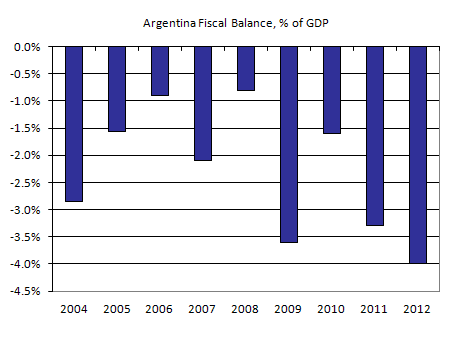
Source: IMF, BBH
President Fernandez easily won a second four-year term last year with 54% of the vote, with her nearest challenger at 17%. A weak and divided opposition helped Fernandez win, as did the then-booming economy and increased government payouts designed to help offset the negative impact on households of high inflation. Clearly, her second term will be rockier than her first, and that seems to be unfolding now. Fernandez will maintain the unorthodox mix of policies for now, and has shown little willingness to more towards orthodoxy during her first term. What is most troubling to us is that the Argentine populace appears supportive of the move to seize YPF, with a recent poll suggesting that two thirds of the populace supporting the takeover. We suspect that more moves to renationalize companies and industries could be seen ahead in Argentina, since they appear to play well to the domestic audience. Yet we wonder how supportive the voters will remain as the economy worsens further.
High inflation and deteriorating external accounts should maintain downward pressure on the peso in 2012. Recent measures requiring exporters to repatriate earnings and insurance companies to move investments domestically signal concern with capital flight. While authorities will continue to favor peso weakness, those moves suggest they will try to keep pace slow and steady. Argentina can regain competiveness with greater nominal depreciation or lower actual inflation. The former will be much easier to achieve than the latter. Note that the Merval is greatly underperforming in the region, down -8% YTD in USD terms even as most others in Latin America are up double digits YTD.

Source: Bloomberg

I haven’t followed Argentina closely so I’m trying to get a handle on their situation.
So Argentina’s exports have fallen. Hardly surprising given the global economy.
Their unemployment rate is 6.7%, better than the rest of the world, but not yet full employment. You can’t blame 25% inflation on 6.7% unemployment, so something else must be going on ? If fiscal policy is “too loose,” why the 6.7% unemployment ? Are they paying bills in their own currency, or are they required to buy another currency to pay for their imports ?
To tell you the truth, I would trade their 6.7% unemployment and 10% inflation for America’s high unemployment and low inflation. I’m sure most people in austerity-ravaged countries would agree. Moderate inflation is beneficial to debtors. It’s the unemployment that hurts people most.
I fully support nationalizing natural resource companies, either that or else regulate them as public monopolies. Why let a foreign corporation exploit your country’s resources for their profit ? What have Exxon and BP done for me lately ?
Credit Writedowns is coming across as pretty old fashioned on this issue. So Argentina is going the way of Venezuela, Bolivia, and Ecuador ? GOOD ! ! ! Certainly, there will be efforts to punish the countries that stand up to capitalism, just as capitalism has punished and demonized Chavez’s Venezuela. By most accounts, the lot of the average Venezuelan has improved under Chavez. If you want to criticize Argentina’s economic policies, please propose a constructive alternative, one that would benefit their working people, not just corporations and financiers.
Is Credit Writedowns coming across this way or is it the writer of this article? There are differing views amongst authors here you know.
Both. Credit Writedowns has been negative on Argentina’s nationalization of the oil company from the get-go, warning of negative consequences. Do you disapprove of the nationalization of natural resources in general, or is there merely something particularly wrong with the way Argentina is going about it ?
Mind you, I don’t follow Argentina news closely if at all, so I don’t claim to understand what is going on down there. I appreciated this article to the extent that it helped enlighten me on the subject.
Re: whether Argentina’s inflation is 10% or 25% ? The same question could be asked about inflation in the US, with alternative sources like Shadowstats claiming that US inflation is much worse than the official number, and Zero Hedge perpetually warning that hyperinflation is right around the corner. So I’m not sure how seriously to take the 25% claim ?
Realistically, Argentina’s economy has been doing better than many other countries. I’d like to better understand why they can’t get their 6.7% unemployment down without excessive inflation ? Not that it has anything to do with nationalizing oil companies, but it does relate to MMT, which is what attracts me to Credit Writedowns. MMT says that a monetarily sovereign country should be able to deficit spend its way to full employment without excessive demand-pull inflation, and that trade balance and foreign capital shouldn’t matter as long as fiscal policy adjusts to compensate. I’m interested in observing Argentina and seeing how these things play out.
I am not against nationalising natural resources on self-determination grounds, although the way it has been done was a political stunt that was poorly executed and will have lasting repercussions.
The crux here is that Argentina has an incredibly inflationary economic policy even before reaching full employment. The headline number is 9-10% but that number is totally bogus and the real number without data manipulation is 25%. It is Argentina’s policies which are creating this inflation. Fernandez, seeing this has tried to redistribute income to make sure that inflation has not had a huge negative impact as there were gas riots during the spike in 2008.
Moreover, Argentina’s numbers are all weakening, GDP growth, external balance, reserves, etc. The Argentine economy is a very command economy compared to what it was before Fernandez and her husband got in control and that is by design. I am against this on principal. There is nothing old-fashioned about it. There are exceptions like currency controls in Iceland but what most people find is that and command economy underperforms. Argentina will be no different.
As for oil resources, there is an argument to be made that it is Argentina’s resources and that because they are finite they must be husbanded assiduously and used for Argentine growth. To the degree Repsol doesn’t do this, Argentina has ever reason to get them out. After all, almost every major oil exporting nation has its natural resources in domestic hands.
But the Argentine situation is more complicated. Essentially Fernandez’s economic policy creates inflation. So she is forced to subsidize oil and gas sales. The subsidizing of retail domestic oil and gas purchases by artificially suppressing the price to below the market price GUARANTEES underinvestment. If you were Repsol, why would you invest in Argentina when you are getting a poor return compared to anywhere else in the world? You wouldn’t. I wouldn’t.
Bottom line: Fernandez has an economic model that will be destructive. It is inflationary and distorts capital investment to the detriment of Argentina. She and her husband were able to get away with it because Argentina was coming out of a deep depression and because commodity prices were high. Even so, Fernandez has had to redistribute massive amounts of money to keep the thing together as witnessed by the gas/petrol subsidy.When gloabl and commodity growth come to heel, you will see very bad things happening in Argentina and the expropriation is just the tip of the iceberg.
P.S. – 25% is headed toward hyperinflation. There are no comparisons to the US here. Brazil has a populist and left-wing government. They have done much better in both growth and policy.
P.P.S. – I am a libertarian, by the way. So it should follow that I an against intervention on principal. However, I do accept the need for it in terms of prudential regulation and on national security grounds.
i’ve lived there, married a woman from there, and can testify they are all thoroughly crazy people. They are as social economically speaking as you can imagine. the inflation is out of control with 25% seeming to feel right. i know how this song and dance is going to end for them there and it won’t be pretty.