Mental Midgets and Moral Pygmies
The following is a re-print of the latest monthly newsletter from Niels Jensen of Absolute Return Partners, published with the express permission of the author. Visit www.arpllp.com to learn more about Absolute Return Partners. You can reach the firm by email at [email protected].
I have arrived at the fourth and final letter in our series about macro themes likely to shape the future. The topic this month is the role of the consumer; the fact that he has over-extended himself financially in recent years and the implications of that. Please allow me to start with a disclaimer: this topic is so vast that I cannot possibly cover every aspect of it. One area which I don’t touch on, for example, is the effect lower consumer spending will have on corporate earnings. Also, I fully accept that not all countries are as leveraged as the UK and the US; the following is predominantly a discussion about the Anglo-Saxon model. Accept the letter in that spirit and you should enjoy it.
Up to the neck in debt
It is really quite simple. The problem is leverage – leverage at every level of the economy. The consumer is up to his neck in debt, but so are our banks and our governments (or, at the very least, they soon will be). In the US (chart 1a), total leverage has risen from a post World War II level of about 150% of GDP to roughly 350% of GDP today with households and the financial sector responsible for most of that growth. Meanwhile, in the UK (chart 1b), total leverage has grown from 200% of GDP to a mind-boggling 500% of GDP in little over 20 years with households and financial companies also accounting for most of that growth.
Chart 1a: Total US Debt as % of GDP
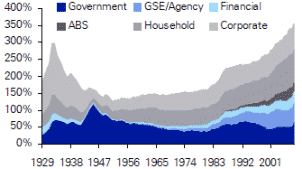
Chart 1b: Total UK Debt as % of GDP
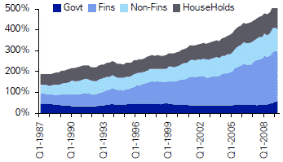
Source: Deutsche Bank
So, while it is true that governments on both sides of the Atlantic are currently taking on potentially dangerous amounts of debt, it is not quite true that they are behind the excessive creation of debt over the past few decades. If anything, they should be accused of naivety, ignorance and perhaps even stupidity for allowing the current situation to develop in the first place.
Midgets and Pygmies
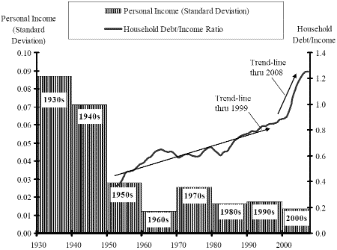
Now, why didn’t anyone see this coming? Why did our ‘midget’ leaders permit leverage to grow out of control? Well, as a starting point, it is important to understand that, from the consumer’s point of view, increasing leverage has been a logical response to the lower macro-economic volatility experienced over the past 25-30 years. As demonstrated by Dr. Woody Brock at SED (chart 2), household income has become much more stable in recent years with volatility on personal income being cut in half when compared to the 70s and by almost 80% when compared to the 40s. As a consumer, it is perfectly rational to increase financial leverage if you experience rising income stability. What is less rational is to take it to the extreme, as both US and UK consumers have done in the past 6-7 years (note how the slope of the US debt-to-income ratio in chart 2 steepens post year 2000).
Chart 2: Development of US Household Debt
Source: Strategic Economic Decisions, Inc.
The power of the consumer
The rising financial stability and the ensuing increase in leverage also explains the growing dominance of the consumer in the national accounts to the point where consumer spending now accounts for more than 70% of GDP in the US and about 63% in the UK. Now, with the prospects of consumer spending likely to fall as a percentage of GDP in the years to come due to the expected de-leveraging of household balance sheets, many commentators have argued that we should prepare ourselves for lower GDP growth going forward. Whilst this argument may make sense intuitively, it is fundamentally wrong.
In order to understand why that is, I need to revisit the old equation again which explains how GDP is in fact calculated:
GDP = C + I + G + (X-M)
where C = consumption, I = investments, G = government spending less taxes and X-M = net exports (i.e. exports less imports). So what does this simple formula tell us?
First and foremost, it tells us nothing about what will happen to GDP just because consumers decide to de-lever, thereby reducing spending and, by implication, increasing savings. Yes, all other things being equal, GDP will fall about 0.7% for every 1% reduction in US consumer spending, but all other things are not equal.
Consider the effect on net exports for example: Reduced consumer spending will almost certainly have an immediate, and positive, effect on net exports through lower imports, thereby increasing GDP. Or consider what the government may decide to do – as it has done in spades in recent months and quarters – to soften the impact from the collapse in economic activity. Or consider what might happen to investments as savings rise.
Not so straightforward
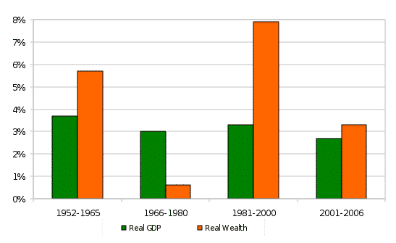
The relationship between consumer spending and overall economic growth is therefore nowhere near as straightforward as one would expect and, as you can see in chart 3, there is plenty of historical support for this argument. Back in the 50s and 60s, consumer spending accounted for approximately 65% of GDP in the United States. Since then, despite the growing dominance of the consumer, the overall economy has grown at a relatively steady rate. If anything, the growth rate has declined modestly. In other words, no direct link between consumer spending and GDP.
Chart 3: Real Growth in US GDP vs. Wealth
Source: Strategic Economic Decisions, Inc.
Now, if you look more closely at chart 2, you will note that there is one post war period – the mid 1960s to the early 1980s – where household leverage didn’t grow. This happens to coincide with a period of virtually no growth in inflation-adjusted wealth (see chart 3). It certainly looks as if consumers are likely to spend so long as they feel they can afford it. Asset prices may therefore hold the key to the likely future path of consumer spending. The ‘feel good’ factor is an immensely important psychological factor and, if the authorities could do to property prices what they have done to stock prices in recent months, consumer spending would almost certainly take off again.
The effect of zero cost money
If you will allow me to digress for a moment, I should probably explain what I imply by making the statement: “…what they have done to stock prices…”. When money is obtainable at virtually zero cost, as it is, it does two things to investors. Firstly, it burns a very large hole in their pocket because it is painful to watch your savings grow at 0.5% per annum and, secondly, it increases your risk appetite immensely (the so-called carry trade). So, by reducing the cost of capital to near nothing, a liquidity infused bull market has been established, which doesn’t rely on economic fundamentals at all. Much cheaper, and politically more digestible, than asking for more money from taxpayers; however, doing the same trick to property prices may be a great deal more difficult, as there is still a considerable overhang of property from years of over-building to be factored in, at least as far as the US is concerned. That, though, is an altogether different story which I may take up in a future letter.
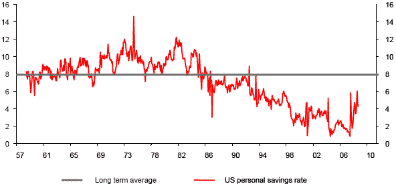
Let’s get back on track. The low savings rate in the UK and US (see chart 4) is often used as ‘evidence’ that consumer spending will remain low until such time that the consumer has increased his savings rate to levels consistent with historic averages. In my opinion, that is no more than wishful thinking. Consumers – at least those of us living in the UK or the US – are genetically coded to spend whatever we can afford or, probably more correctly, think we can afford. So, when consumer spending is on the retreat, it is not because consumers have suddenly seen the light. No, we are spending less, because we have less money to spend.
Chart 4: US Savings Rate
Source: Societe Generale
The global current account
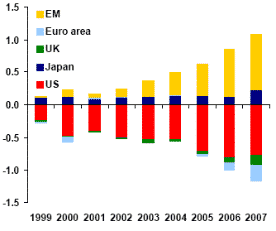
Now, let’s move our attention to the global economy and why the behaviour of the US (and to a smaller degree also European) consumer is important. First it is important to recognise that the global current account is always, by definition, in balance. In other words, for every dollar, euro or pound sterling of deficits that we ramp up, someone else will be running a surplus and, on a global basis, it becomes a zero sum game. This equation is illustrated in chart 5 below. As you can see, emerging markets (mostly China) and Japan are chronic over-savers, whereas the US, UK and the Euro area are chronic over-spenders.
The other observation that one makes almost instantly is how the imbalances have grown steadily bigger in recent years (which partly explains the mess we are in today). So, when much of Asia runs a chronic current account surplus, it does so to a large degree because of the almighty crisis it went through in the late 1990s. Back then, the region was on the brink of a complete meltdown and exchange rates were lowered in order to kick-start exports. It worked wonders, but the necessary adjustments were never made.
Chart 5: The Global Current Account
Source: Citigroup Global Markets
The liquidity provider
In the West, we became addicted to cheap goods from Asia to the point where we now run enormous deficits. However, that is only half the story. A point missed by most commentators is the important role that the US current account deficit plays in terms of providing liquidity to the global market place. Back in September 2005, when I first wrote about global liquidity, I stated that “the U.S. current account deficit has played an important role in terms of providing stimulus to the global economy in recent years, a fact often ignored by those being so critical of the large deficit”. This statement is as true today as it was four years ago.
It is hardly a coincidence that every time global dollar liquidity has contracted sharply, a crisis of some sort has developed somewhere (see details here). Given the strong growth in the US monetary base in recent months, there is little risk of there not being ample supplies of dollars in the short term but, all other things being equal, a US consumer being inclined to save more is a negative for global dollar liquidity.
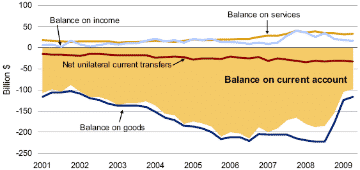
And, as you can see in chart 6, the US current account has, in fact, improved meaningfully over the past few years (by the way, I find it quite interesting how little attention this has attracted). The deficit is now below $100 billion per quarter whereas, not long ago, it was in excess of $200 billion. In plain English that means fewer dollars in the coffers of the central banks of China, Japan, etc.
Chart 6: US Current Account Balance and its Components
Source: Bureau of Economic Analysis
When the Chinese make noises about the need for an alternative to the dollar as the premier trading and reserve currency of the world, as they have done in recent months, everyone automatically assumes that they have lost faith in the long term value of the greenback; however, they could equally well be worried that, with the US current account deficit shrinking at a rapid rate, at some point in the not so distant future, there may not be enough dollars in the system to facilitate the ever growing global trade. But, no, that story is not sexy enough for the news hungry media!
Incidentally, this also means that if countries such as China and Japan are chronic over-savers, in a world of retreating consumer spending, someone else must step into the shoes of the consumer. Who could that be? Well, if you still don’t get it, call the Oval Office or 10 Downing Street and ask them the question.
So, what does all of this mean?
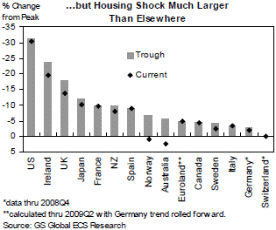
Old habits don’t die easily, but consumers have been subjected to a large shock in the form of collapsing property values – in particular those in the United States (see chart 7). Although official house price statistics are notoriously unreliable (Spain, for example, is much worse hit than what appears to be the case based on the chart below), the US property market is clearly amongst the worst hit and, for precisely that reason, one should expect consumer spending to languish for longer there than elsewhere.
Chart 7: House Prices, % Change from Peak
Source: Goldman Sachs, Global Economics Weekly
Having said that, 25 years of investment experience have taught me never to underestimate the consumer. Coming out of the 2001-02 recession, consumer spending did remarkably well despite anaemic job growth. The reason? A buoyant property market. The consumer will find a way to spend money, if there is a way at all.
The other implication of all of this is that Asian currencies, and the renminbi in particular, must rise in value – not only against the US dollar but against European currencies as well. Otherwise it is only a question of time before we have the pleasures of the Great Crisis, Part II. Asian governments are not likely to permit such a move until they feel confident that domestic consumption can pick up the slack from reduced exports. But it will happen sooner or later and it suggests you should be overweight Asian markets in your portfolio as long as you understand that you may have to be patient. The adjustment is not going to happen overnight.
The third and final observation I make is that the dollar is long overdue a rally as far too much has been made of the story that the Chinese have lost faith in the US currency. The resulting dollar bear market has been further exacerbated by the sheer power of the carry trade which has found new life, following the decision to reduce the cost of capital to near zero. It is kind of sad that one has to create a bubble in order to clean up after the previous one, but I guess the alternative would be even worse.
Niels C. Jensen

Edward,
These guys make a big conceptual leap into the ozone with the following tidbit. By what logic does this make sense?
“Consider the effect on net exports for example: Reduced consumer spending will almost certainly have an immediate, and positive, effect on net exports through lower imports, thereby increasing GDP.”
Barry
The logic is that reduced spending means more savings and a reduction in net imports. That would increase GDP by making a negative number less negative. BUT, the lower spending also reduces consumption on domestic goods as well. So I don’t follow that either.
“Consider the effect on net exports for example: Reduced consumer spending will almost certainly have an immediate, and positive, effect on net exports through lower imports, thereby increasing GDP.”
Is it possible that the countries we export to (I am thinking of China in particular) are so dependent on our consumption habits that it could lead to a comparable move down in our exports? I realize the trade data do not support that up to this point given our narrowing deficit; however, is it possible that any future reduction in our consumption and possible dollar strengthening will hurt our exports enough to keep our deficit roughly where it is (i.e. no positive adjustment to GDP)?
I am a relative novice and just thinking out loud. I have no real data to support any of this.
Great post. Thanks.
“Consider the effect on net exports for example: Reduced consumer spending will almost certainly have an immediate, and positive, effect on net exports through lower imports, thereby increasing GDP.”
Is it possible that the countries we export to (I am thinking of China in particular) are so dependent on our consumption habits that it could lead to a comparable move down in our exports? I realize the trade data do not support that up to this point given our narrowing deficit; however, is it possible that any future reduction in our consumption and possible dollar strengthening will hurt our exports enough to keep our deficit roughly where it is (i.e. no positive adjustment to GDP)?
I am a relative novice and just thinking out loud. I have no real data to support any of this.
Great post. Thanks.
I just replied to Barry that I believe the negative impact on domestic spending far outweighs any reduction of net imports. So, net-net, lower consumption means lower GDP.